
Cooling System Flush & Exchange
Cooling System Flush & Exchange: The Service UAE Drivers Cannot Afford to Skip
Your engine runs at temperatures that would destroy unprotected metal. The only thing standing between a healthy engine and a catastrophic overheat is your cooling system — and the coolant flowing through it.
In the UAE, where summer temperatures push ambient air past 45°C and under-bonnet temperatures soar far beyond that, the cooling system works harder than almost anywhere else in the world. Yet it is one of the most neglected maintenance services among drivers in Ajman and across the Emirates.
A cooling system flush and exchange is not a luxury service. It is essential maintenance that protects your engine, prevents overheating, and saves you from one of the most expensive repairs a car can suffer — a blown head gasket or a warped engine block.
This guide explains exactly what the cooling system does, why coolant degrades, what a proper flush and exchange involves, and how often UAE drivers should have it done.
How Your Car’s Cooling System Works
Your engine generates enormous heat during combustion — temperatures inside the cylinders can exceed 2,000°C. The cooling system’s job is to absorb that heat and release it safely before temperatures rise to damaging levels.
The system works as a closed loop. Coolant — a mixture of antifreeze and water — circulates through channels cast into the engine block and cylinder head, absorbing heat as it flows. The hot coolant then travels to the radiator, where it passes through a network of thin tubes. Air flowing through the radiator fins carries the heat away. The now-cooled coolant returns to the engine and the cycle continues.
Key components in this system include:
- The water pump — drives coolant circulation throughout the system. Without it, coolant stops moving and the engine overheats rapidly.
- The thermostat — a temperature-sensitive valve that stays closed when the engine is cold, allowing it to reach operating temperature quickly. Once the engine warms up, the thermostat opens and allows coolant to flow to the radiator.
- The radiator — the heat exchanger that transfers heat from the coolant to the outside air.
- The radiator cap — pressurises the system to raise the boiling point of the coolant, allowing it to operate at higher temperatures without boiling.
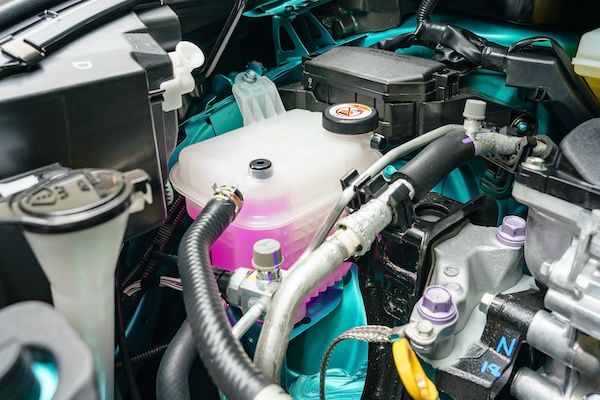
- The expansion tank — accommodates the volume change of coolant as it heats and cools.
- Cooling hoses — carry coolant between the engine, radiator, heater core, and expansion tank.
- The heater core — a small radiator inside the cabin that uses hot coolant to warm the interior. In the UAE, this is rarely needed for warmth but the heater core remains part of the cooling circuit.
All of these components depend on coolant that is in good condition. Degraded coolant does not just reduce cooling efficiency — it actively damages the components it flows through.
What Is Coolant and Why Does It Degrade?
Coolant — also called antifreeze — is a chemical compound, typically ethylene glycol or propylene glycol, mixed with water and a package of additives. In the UAE, its role as an antifreeze in the traditional sense (preventing freezing) is irrelevant. Its critical functions here are:
- Raising the boiling point. Pure water boils at 100°C. A 50/50 mix of coolant and water raises the boiling point to around 106°C, and the pressurised system raises it further to approximately 120°C or higher. This prevents boiling in the extreme heat of UAE summer driving.
- Corrosion inhibition. The coolant additives form a protective film on the internal surfaces of the engine block, cylinder head, radiator, water pump, and heater core. Without this protection, the coolant — which becomes slightly acidic with use — attacks aluminium, cast iron, copper, and solder in the system.
- Cavitation protection. High-speed water pump operation can create vapour bubbles that collapse and cause microscopic pitting on metal surfaces. Coolant additives inhibit this process.
- Lubrication. Coolant provides light lubrication to the water pump shaft seal, extending pump life.
The problem is that these additives deplete with use. Heat, contamination, and the electrochemical environment inside the cooling system gradually exhaust the corrosion inhibitors and pH buffers in the coolant. Once the additives are depleted, the coolant becomes acidic and begins corroding the system from the inside.
Corroded coolant passages restrict flow. Corroded aluminium cylinder heads develop pitting and porosity. A corroded water pump impeller loses efficiency or fails entirely. A corroded radiator develops pinhole leaks.
In the UAE, the intense heat that the cooling system constantly fights also accelerates additive depletion. Coolant that might last three years in a temperate climate often reaches the end of its effective life sooner here.
Other Car Repair Services
- Minor 5000 Km Service
- Routine 7000 KM Service
- Windshield Wipers
- CV (Constant Velocity) Maintenance
- Major 10,000 KM Service
- Belts & Hoses
- Vehicle Value & Car Pricing Service
- Headlight Aiming
- Battery Change-Over & Charging
- 7,500, 15k, 30k, & 60k Km Maintenance
- Transmission Fluid Service
- Lighting (Bulb Replacement)
- Cooling System Flush & Exchange
Signs Your Cooling System Needs a Flush and Exchange
Many cooling system problems develop gradually and give clear warning signs before they become serious. Watch for:
- Rising temperature gauge. The normal operating temperature needle sits at the midpoint. If it creeps toward the red zone during normal driving — especially in traffic or on hot days — the cooling system is struggling. This is not a warning to ignore.
- Overheating in traffic. Stop-start traffic is the hardest condition for any cooling system. If your engine temperature rises when stationary and drops when moving, the radiator, coolant, or cooling fan may be at fault.
- Sweet smell from the engine bay. Coolant has a distinctive sweet smell. If you notice this smell — particularly after the engine warms up — it indicates a coolant leak, either external from a hose or gasket, or internal into the combustion chamber.
- White smoke or steam from the exhaust. A small amount of water vapour on cold starts is normal. Persistent white smoke or a sweet smell from the exhaust on a warm engine indicates coolant burning in the combustion chamber — a symptom of head gasket failure, which is often caused by overheating.
- Coolant level dropping without visible leaks. If you regularly need to top up the coolant reservoir but see no puddles under the car, the coolant may be leaking internally — burning in the engine or seeping into the oil. Check the oil dipstick for a creamy, milky appearance, which indicates coolant contamination.
- Rusty, discoloured, or sludgy coolant. Healthy coolant is typically green, blue, orange, or pink depending on the type. Coolant that has turned brown, rust-coloured, or has visible particles floating in it has degraded and is actively corroding the system. This needs immediate attention.
- Visible corrosion around hose connections or the radiator. White or crusty deposits around coolant connections indicate past or current leaks and point to a system that needs inspection and servicing.
What Is a Cooling System Flush and Exchange?
A cooling system flush and exchange is a service that removes old, degraded coolant from the entire system and replaces it with fresh coolant — along with a cleaning process that removes deposits and contaminants from the system’s internal surfaces.
This is different from a simple top-up. Topping up adds fresh coolant to a partially depleted reservoir but does not remove the degraded coolant already in the system. It dilutes the problem rather than solving it.
A proper cooling system flush and exchange at a professional garage includes:
System Inspection
Before any fluid work begins, the cooling system is inspected. Hoses are checked for swelling, cracking, and softness. The radiator cap is tested for correct pressure holding. The radiator is inspected for leaks, damage, and blockage. Coolant condition is assessed visually and with a test strip or refractometer.
Cooling System Flush
A flushing agent is added to the old coolant and the engine is run to circulate it through the system. The flushing agent loosens scale, rust deposits, and sludge from the internal passages. The system is then drained fully — not just from the radiator drain, but from the block drain as well, to remove as much old coolant and contaminant as possible.
On heavily contaminated systems, a clean water flush may be run through the system before the new coolant is added, further removing loosened deposits.
Correct Coolant Refill
The system is refilled with the correct coolant type for the vehicle — matched to the manufacturer’s specification in terms of colour, chemistry (OAT, HOAT, IAT, or other), and concentration. In the UAE, a 50/50 mix of coolant and distilled water is standard — distilled water is used rather than tap water because the minerals in UAE tap water accelerate scale formation inside the cooling system.
Bleeding the System
Air pockets trapped in the cooling system prevent correct coolant circulation and cause localised overheating. After refilling, the system is bled — air is purged by running the engine with the heater on full and the cap off (or through a dedicated bleed point on the system) until coolant circulates freely and the temperature stabilises correctly.
Pressure Test
After the flush, the cooling system is pressure tested to confirm there are no leaks from hoses, the radiator, the water pump, or the engine gaskets. A system that will not hold pressure has a leak that must be found and repaired before the service is complete.
Road Test and Temperature Check
The vehicle is road tested and the temperature gauge behaviour is monitored under various conditions — cold start, warm-up, idle, and moving — to confirm the cooling system is operating correctly.
Types of Coolant: Why the Right Type Matters
- Using the wrong coolant type is a common mistake that causes serious damage over time.
- IAT (Inorganic Additive Technology) — the traditional green coolant. Effective but with a short service life of around 2 years or 40,000 KM. Rarely recommended for modern vehicles.
- OAT (Organic Acid Technology) — typically orange, red, or pink. Longer service life of 5 years or 150,000 KM. Used in many modern European and Asian vehicles. Incompatible with IAT coolant.
- HOAT (Hybrid OAT) — a combination of OAT and silicate additives. Often yellow or turquoise. Used by many manufacturers including Mercedes-Benz, BMW, and Volkswagen for specific applications.
- NOAT (Nitrite OAT) — used in some heavy-duty and diesel applications.
Mixing different coolant types dilutes or neutralises the additive packages, reducing corrosion protection and shortening service life. Always drain and flush when switching coolant types, and always use the type specified by your vehicle’s manufacturer.
How Often Should You Flush the Cooling System in the UAE?
Standard manufacturer intervals for coolant replacement range from every 2 years to every 5 years depending on the coolant type. In the UAE, the following is a practical guideline:
IAT coolant — replace every 2 years or 40,000 KM, whichever comes first.
OAT and HOAT coolant — replace every 3 years or 60,000 KM in UAE conditions. The longer rated life of these coolants assumes temperate operating conditions. The UAE’s heat accelerates additive depletion.
Any coolant showing discolouration, contamination, or low concentration — replace immediately, regardless of age or mileage.
Vehicles that have overheated — even once — should have the coolant and the entire cooling system inspected immediately. Overheating can cause head gasket damage that introduces combustion gases into the coolant, contaminating it severely and causing rapid system damage if the car continues to be driven without addressing it.
What Happens If You Neglect the Cooling System?
The consequences of neglecting cooling system maintenance follow a predictable and expensive progression.
- Depleted coolant loses corrosion protection. The cooling system begins to corrode internally — the radiator, water pump, and engine passages accumulate scale and rust. Coolant flow is restricted, cooling efficiency drops, and the engine runs hotter than it should.
- Rising operating temperatures stress the head gasket — the seal between the cylinder head and engine block. Head gaskets fail under repeated thermal stress, allowing coolant into the combustion chamber or oil into the coolant.
- A warped cylinder head is a common consequence of overheating — aluminium heads distort under excessive heat, breaking the head gasket seal. Cylinder head machining or replacement is among the most expensive engine repairs a car can need.
- In extreme cases, a seized engine is the result — the engine overheats to the point where internal components weld themselves together. This is a total engine loss.
- Every step of this progression is preventable with regular coolant service. The cost of a flush and exchange is a fraction of the cost of any of these repairs.
Why Choose Marwat Garage for Cooling System Service?
We inspect the full system before we flush — hoses, cap, radiator, and coolant condition. We use the correct coolant specification for your vehicle, distilled water for mixing, and a proper bleed and pressure test after every service. No shortcuts, no guesswork.
Frequently Asked Questions
We now have an FAQ list that we hope will help you answer
some of the more common ones.
The cost varies depending on your car’s make, model, and the type of key system it uses. Basic remote key fob programming is affordable, while smart key and proximity key programming for newer vehicles may cost more due to the advanced software required. Call us on +971-564761112 for a specific quote for your car.
In most cases, yes — but it depends on the make and model. Some vehicles require at least one working key to programme a new remote, while others allow a complete key replacement via OBD2 access. Our technicians will advise you after a quick diagnostic check.
If a fresh battery has not solved the problem, your key fob may have lost its synchronisation with the car’s ECU — this is a common issue after a battery change or flat car battery. The fix is a simple reprogramming, which we can do while you wait at our garage in Ajman.
Most key fob programming jobs take between 30 minutes and one hour. Smart key programming for newer models may take slightly longer if it requires extended ECU communication. We will give you an accurate time estimate when you bring in your vehicle.
We can source compatible replacement key fob shells and remotes for most popular vehicle makers sold in the UAE. If you already have a new fob, we can programme it for you. Call ahead to confirm availability for your specific model.
Got a questions?
Pulvinar neque laoreet suspendisse interdum consectetur libero id faucibus nisl. Lectus urna duis convallis convallis tellus.
Schedule Your Appointment Today
Your Automotive Repair & Maintenance Service Specialist