
ECM Repair
Engine Warning Light On? Your ECM Might Be the Problem
Modern vehicles are no longer just mechanical machines — they are rolling computers. Dozens of electronic control systems monitor and manage everything from fuel delivery and ignition timing to emissions, transmission behaviour, and safety responses. At the centre of all of this is one component: the Engine Control Module, commonly known as the ECM. When this critical unit develops a fault, the effects can ripple across every system in the vehicle — and standard part replacements will not solve the underlying problem.
At Marwat Garage Ajman, we offer professional ECM repair and diagnostics for a wide range of vehicle makes and models. Our approach is diagnosis-first and repair-before-replacement — saving our customers significant money while restoring full vehicle function. If your vehicle has a check engine light that will not clear, performance issues that have not responded to conventional repairs, or multiple unexplained fault codes, the ECM deserves serious attention.
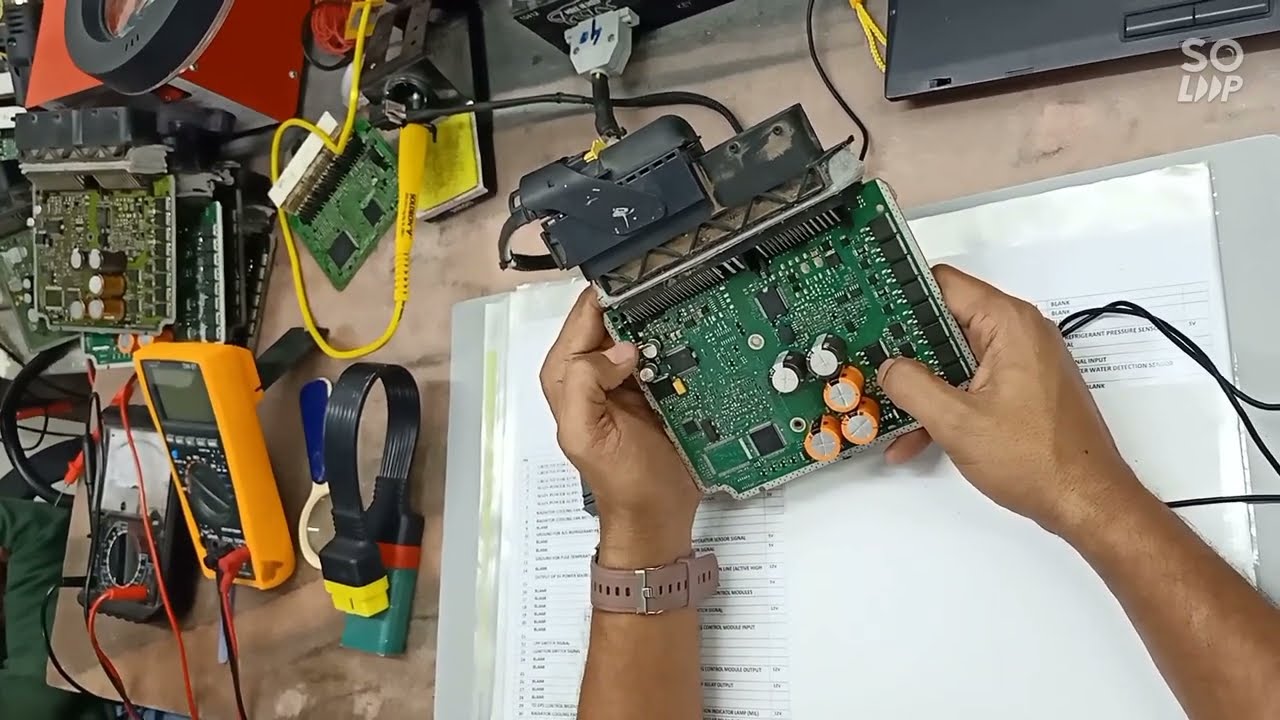
What Is the ECM and What Does It Control?
The Engine Control Module — also referred to as an ECU (Engine Control Unit) or engine management unit — is the primary onboard computer responsible for managing your engine’s performance. It is essentially the brain of your vehicle’s powertrain, and it never stops working while the engine is running.
The ECM continuously receives real-time data from a network of sensors positioned throughout the engine and drivetrain. Using this data, it makes thousands of adjustments per minute to keep your engine running at the correct operating parameters. The systems it manages include:
- Fuel Injection — The ECM calculates exactly how much fuel to inject into each cylinder and at precisely what moment in the combustion cycle, based on engine load, temperature, throttle position, and oxygen sensor feedback.
- Ignition Timing — It controls when the spark plugs fire relative to piston position, advancing or retarding timing dynamically to maximise power output while preventing engine knock.
- Idle Speed Control — The ECM adjusts idle speed to account for engine temperature, electrical load from accessories, and air conditioning demand.
- Air-Fuel Mixture — Working with the mass airflow sensor and oxygen sensors, the ECM maintains the correct ratio of air to fuel for efficient combustion and low emissions.
- Emission Control Systems — It manages the EGR valve, catalytic converter operation, evaporative emission controls, and secondary air injection where applicable.
- Transmission Communication — The ECM communicates directly with the Transmission Control Module (TCM) to coordinate smooth gear changes based on engine load and driver demand.
- Immobiliser and Security — On many vehicles, the ECM is integrated with the immobiliser system and refuses to allow the engine to run without the correct key authentication signal.
When the ECM begins to malfunction, any or all of these functions can be compromised — often in ways that look like multiple unrelated faults.
Signs Your ECM May Need Repair or Attention
ECM faults rarely announce themselves with a single, obvious symptom. Instead, they tend to produce a confusing cluster of problems that do not obviously point to one cause. Here is what to watch for:
- Check Engine Light That Will Not Clear The check engine light is the ECM’s primary way of communicating a detected fault. If the light remains on persistently, returns shortly after being cleared, or appears alongside multiple different fault codes simultaneously, the ECM itself may be the common cause.
- Engine Performance Problems With No Obvious Mechanical Cause Rough idling, hesitation when accelerating, intermittent stalling, or a sudden loss of power that has not been resolved by replacing spark plugs, fuel filters, or sensors points strongly toward an ECM communication or processing failure.
- Significantly Worse Fuel Economy Because the ECM controls fuel injection quantity and timing, a malfunctioning module can cause the engine to run rich — injecting more fuel than necessary — leading to noticeably increased fuel consumption without any change in driving habits.
- Difficulty Starting or Refusing to Start If the ECM fails to send the correct signals to the fuel injectors or ignition system, or if it fails to communicate with the immobiliser, the engine will crank but not fire — or may not respond at all when you turn the key.
- Erratic or Harsh Transmission Behaviour The ECM and TCM communicate constantly. ECM faults can disrupt this communication, resulting in harsh, unpredictable gear changes, the transmission staying in one gear, or the vehicle entering limp mode to protect itself.
- Failing Emissions Testing An ECM not managing fuel delivery correctly will cause the vehicle to produce incorrect exhaust emissions, leading to failure at RTA testing stations in the UAE.
- Several Unrelated Fault Codes Appearing Together This is perhaps the strongest indicator of an ECM problem. When a diagnostic scan reveals fault codes across multiple different systems that do not logically connect, it often means the ECM — the shared controller — is the source.
Other Suspension & Fitments Services
- EPS Module Repair
- Steering Rack Repair
- Front Shock Absorber Replacement
- Rear Shock Absorber Replacement
- Suspension Lower Arm Replacement
- Noises with Car Suspension & Steering
- Link Rod Replacement
- Tie Rod End Replacement
- Fuel Pump Replacement
- Gear Box Mounting Replacement
- Front Shocker Mount Replacement
- Engine Mounting Replacement
- Car Wash & Wax
- Premium Top Wash
- Water Pump Replacement
- ECM Repair
- Power Window Repair
- Door Latch Replacement
- Mud Flaps
- Starter Motor Repair
ECM Repair vs ECM Replacement — Why We Always Try Repair First
When a workshop immediately quotes for a new ECM without thorough diagnosis, the customer often ends up paying a very high price for a solution that may not even be the right one. A new ECM for many vehicles costs several thousand dirhams — and it still requires professional programming to communicate with the specific vehicle it is being fitted to. An incorrectly programmed or incompatible replacement ECM creates entirely new problems.
At Marwat Garage, our approach is repair-first. Many ECM faults are the result of component-level failures that can be diagnosed and repaired precisely:
- Failed capacitors — Electrolytic capacitors on the ECM circuit board dry out and fail over time, especially in heat. This is one of the most common repairable ECM faults.
- Damaged transistors or driver circuits — Specific output drivers that control actuators like injectors, solenoids, or sensors can fail individually without the rest of the board being affected.
- Corroded or damaged connector pins — The multi-pin connectors that link the ECM to the vehicle’s wiring harness are a common site of corrosion, heat damage, and pin pushback — all of which cause communication failures.
- Water or moisture damage — Moisture ingress into the ECM housing causes short circuits and corrosion on the circuit board. Where damage is identified early, cleaning and component replacement can restore function.
- Power supply circuit faults — The internal voltage regulation circuits within the ECM can fail, causing the module to behave erratically or shut down.
- Corrupted software or calibration data — The ECM’s programming can become corrupted, requiring reprogramming rather than hardware repair.
Where physical damage to the ECM is too severe for repair, we assist in sourcing a compatible replacement unit and handle all programming and calibration.
Our ECM Repair Service — Step by Step
- Complete OBD2 Diagnostic Scan We connect professional-grade diagnostic equipment to read all stored, pending, and permanent fault codes from every control module in the vehicle. This gives us the full picture before we draw any conclusions.
- Wiring Harness and Connector Inspection Before assuming the ECM is faulty, we inspect the wiring harness and ECM connector for damage, corrosion, and poor pin contact — because these external faults often produce the same symptoms as an internal ECM fault.
- ECM Physical Examination We remove the ECM and examine it visually for signs of heat damage, moisture intrusion, corrosion, burnt components, and physical impact damage.
- Circuit-Level Testing and Component Diagnosis Using electronic testing equipment, we test the ECM circuitry at a component level to identify specific failed parts. This targeted approach allows us to repair precisely what has failed rather than assuming the entire module needs replacement.
- Repair, Cleaning, and Component Replacement We replace failed components, clean the circuit board, treat corrosion, and protect against future moisture.
- Reprogramming and Calibration After repair — or after fitting a replacement ECM — we programme the module with the correct vehicle-specific data. Correct calibration is essential for the engine management system to function as intended.
- Full System Road Test We road-test the vehicle and perform a final OBD2 scan to confirm all fault codes are cleared and all systems are communicating correctly.
Why UAE Conditions Make ECM Care Essential
The UAE environment is genuinely harsh on vehicle electronics. Sustained temperatures above 40 degrees Celsius, combined with intense solar radiation, create internal vehicle temperatures that far exceed what the same components experience in cooler climates. Thermal stress degrades solder joints, dries out capacitors, and stresses integrated circuits over time.
Ajman’s coastal location adds seasonal humidity, creating condensation inside sealed electronic enclosures during temperature swings. Fine dust compounds the problem by infiltrating connectors and accelerating corrosion. Our technicians account for these local conditions in every ECM repair.
Frequently Asked Questions
We now have an FAQ list that we hope will help you answer
some of the more common ones.
The cost varies depending on your car’s make, model, and the type of key system it uses. Basic remote key fob programming is affordable, while smart key and proximity key programming for newer vehicles may cost more due to the advanced software required. Call us on +971-564761112 for a specific quote for your car.
In most cases, yes — but it depends on the make and model. Some vehicles require at least one working key to programme a new remote, while others allow a complete key replacement via OBD2 access. Our technicians will advise you after a quick diagnostic check.
If a fresh battery has not solved the problem, your key fob may have lost its synchronisation with the car’s ECU — this is a common issue after a battery change or flat car battery. The fix is a simple reprogramming, which we can do while you wait at our garage in Ajman.
Most key fob programming jobs take between 30 minutes and one hour. Smart key programming for newer models may take slightly longer if it requires extended ECU communication. We will give you an accurate time estimate when you bring in your vehicle.
We can source compatible replacement key fob shells and remotes for most popular vehicle makers sold in the UAE. If you already have a new fob, we can programme it for you. Call ahead to confirm availability for your specific model.
Got a questions?
Pulvinar neque laoreet suspendisse interdum consectetur libero id faucibus nisl. Lectus urna duis convallis convallis tellus.
Schedule Your Appointment Today
Your Automotive Repair & Maintenance Service Specialist